
Project Profile: Washington National Cathedral Restoration
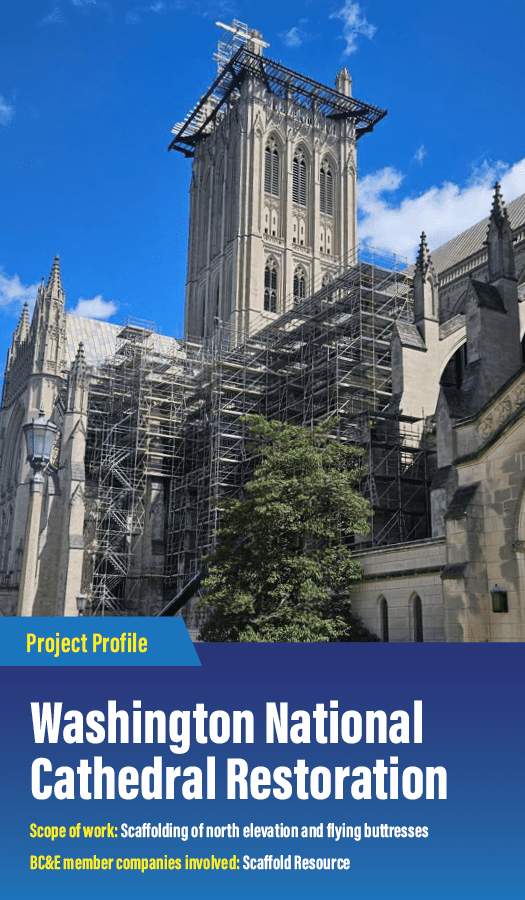
This spring, Scaffold Resource completed the equally robust and delicate operation of erecting a scaffold around the north side of the Washington National Cathedral, including its seven flying buttresses.
“I don’t think there’s a more difficult structure to build scaffolding around than a Gothic cathedral,” said Joe Alonso, Chief Mason, Washington National Cathedral.
The structure was needed to enable ongoing repairs of $40 million in damage the Cathedral suffered during the 2011 earthquake.
“This project required a very, very detailed design,” said Steve Quaerna, Vice President of Business Development and Event Infrastructure for Scaffold Resource.
“Due to the building’s historical significance and preservation requirements, we were unable to anchor or tie the scaffold directly into the structure. This required us to engineer a free-standing scaffold system that provided safe access while protecting the building’s façade and integrity,” Quaerna said.
The Cathedral’s laydown area and operations yard was located directly beneath a section of the north wall where the eight flying buttresses were located, so space was limited, and the scaffold had to be designed to rest on a lower, sloped standing seam roof.
“We had to install a grillage system consisting of aluminum beams and a rubber membrane on the lower roof below the scaffold to disperse the scaffold leg loads so they would not puncture the roof and avoid having to re-shore the roof from the interior,” Quaerna said. “We also had to design the decking to meet very stringent OSHA code requirements and give the workers would proper access to all the parts of that elevation.”

Providing full access was especially complex.
“This is some crazy architecture that you’ve got to work around,” Alonso said.
“There isn’t a building in D.C. that’s more heavily embellished. There are carvings, gargoyles, grotesques. Almost every square inch of that building is hand-carved stone and that style of Gothic architecture has all these slender, flying buttresses with pinnacles and spires.”
OSHA code specifies that workers need to be within 14 inches of the surfaces they are working on, so the scaffold had to place them close to every curved and jutting surface, including the undersides of the flying buttress arches.
The design would also have to facilitate major repair operations, including the use of a crane to remove large sections of stone and equipment to do deep core drilling into the stone to install structural reinforcements.
Erecting the scaffold would also require extreme care.
The earthquake “shook through the walls” of the Cathedral and sent energy “whipping” up through the slender elements, Alonso said. “It was like the cracking of a whip, so all those slender elements — the stones at the top of the finials and pinnacles — experienced a lot of rotations and snapping. The bond in between courses broke and you ended up losing some elements and having a lot of loose pieces of damaged stone.”
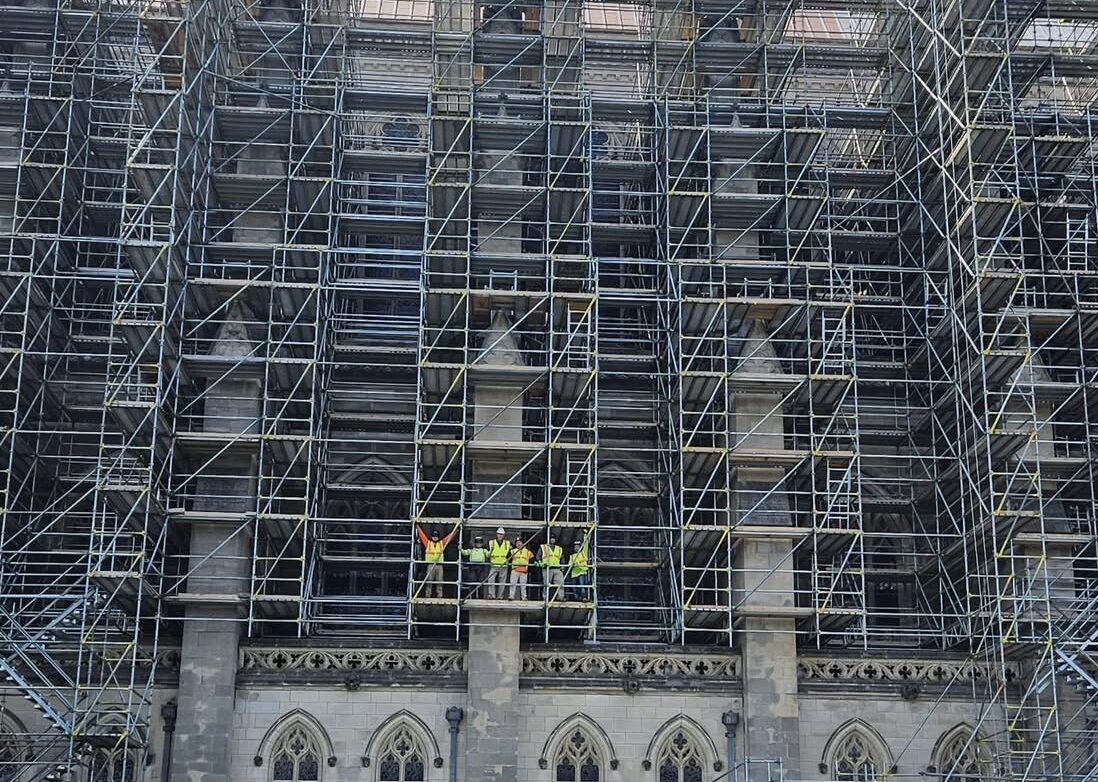
The crew erecting the scaffold were the first people to get physically near all of that damaged stonework, so they were under strict orders to not touch anything.
“We have done enough of these repairs to know that you could touch something with your pinky and it would start to sway,” Alonso said.
Installation proceeded without a hitch and even provided the stone masons with early access to the north elevation. By phasing the erection and certification of the structure, Scaffold Resource was able to give stone masons access to the area two months before full scaffold construction was completed.





Great transformations
From Pre-K to the Pros

Chick Webb Memorial Recreation Center