
It’s Academic: Higher Education projects focus on key goals in competitive market
From the Henrietta Lack Building on Johns Hopkins’ East Baltimore campus to the new Health Professions Building at Towson University to the stunning new dormitories at Morgan State University, higher education clients have been pursuing a wealth of construction projects.

The list goes on to include new STEM research and instructional buildings, athletic facilities, student centers, renovations and repurposing of old buildings, and master plans to upgrade entire campuses.
However, faced with heightened competition to attract students and a tight funding environment, higher ed clients have grown increasingly tactical in selecting their construction investments. They are finetuning project requirements to advance key educational goals, deliver distinctive facilities, and create inviting and flexible spaces that students and faculty take ownership of. The projects also aim to minimize operational challenges in the future.
“There is a recognition that higher ed institutions are in a competitive market because students have a lot of choices,” said Eric Feiss, Principal at GWWO Architects. “Institutions have to demonstrate their value and one way to do that is through facilities that focus on students and the mission of the schools.”
Aesthetics, wellness and high tech
At the Community College of Baltimore County (CCBC) in Essex, GWWO Architects recently completed a project that transformed a 1960s field house into a modern wellness center. More than a routine facilities update, the project met key current goals of higher ed design: It created flexible and outdoor instructional space, improved fitness and wellness facilities, and enhanced common gathering space. It also helped the college with a program accreditation.

“The original building was a large, circular field house with a big, multi-purpose gym that could be used for recreation and competition events,” Feiss said. “The fitness room was never planned into the original building, so it had been shoe-horned into the space.”
That arrangement didn’t provide great or fully accessible fitness facilities. In addition, dance classes which CCBC was working to turn into an accredited program, were relegated to a mezzanine space.
The redesign delivered improved sports and fitness facilities, a dance studio, and an expanded entrance with an inviting common area and a display area for CCBC’s trophies. It also created two outdoor educational areas — one outdoor classroom and one laboratory.
“The outdoor laboratory classroom was a wetlands area that was stormwater management in a traffic island,” Feiss said. “We provided access via a boardwalk and created a platform and seating by the wetlands. Now, students and faculty in sciences, ecology, environmental science can access the wetlands, take samples and teach out in the environment.”

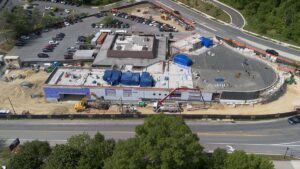
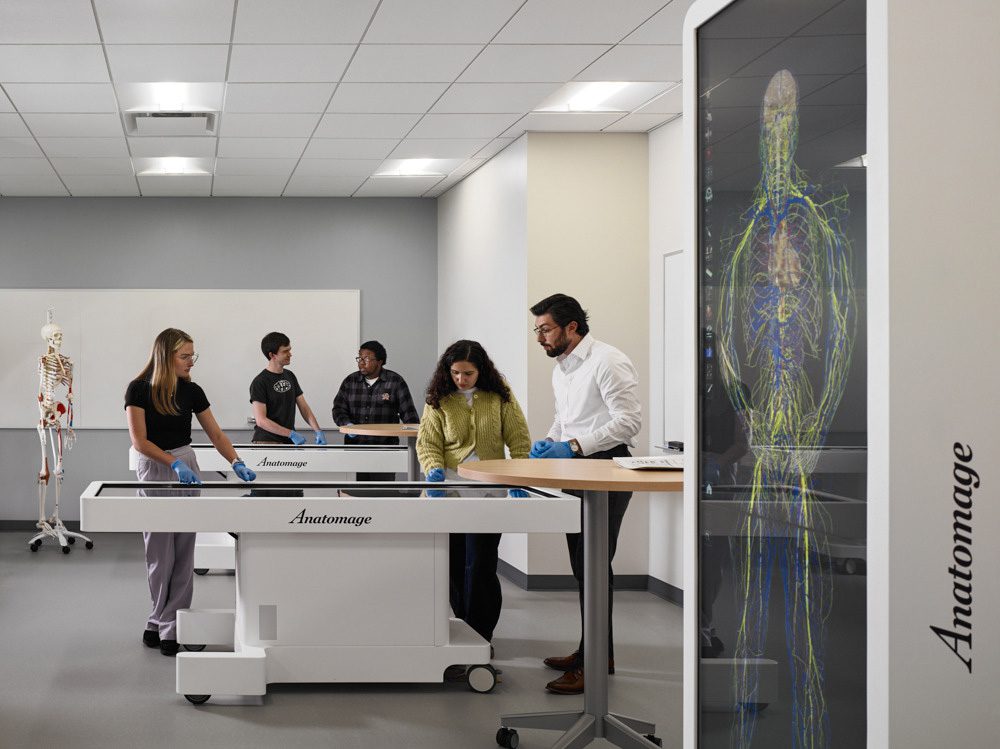
Towson University demonstrated its commitment to students and mission with the completion last year of the new, 240,000-square-foot, Health Professions Building. The facility includes high-tech classrooms and laboratories, large lecture halls and a variety of collaborative learning spaces. To provide hands-on learning in a space that resembles real-world healthcare environments, the building also includes state-of-the-art medical simulation centers and cutting-edge technologies, such as the Virtual Body Lab and immersive artificial reality labs.
“The majority of the top two stories of the building are a mock hospital,” said Robert Fisher, Project Executive at Gilbane Building Company. “You’ve got exam rooms, patient rooms, a simulated ER. There are head walls behind the patient beds and the patients are advanced mannequins so they can do simulations of various medical procedures and exams.”
The building, Fisher added, “is also really beautiful. It has some green roof space. There is garden space on the upper floors where you can go outside. There are nice trees and plantings and patio areas that are really nice. It’s something you don’t typically see in a higher ed facility.”
The building was also designed to bring in a lot of natural light through extensive windows, multiple skylights and atriums, including one that is 110 feet tall.
STEM focus
Expansions, updates and even pioneering projects in STEM education are clearly a trend in higher education construction currently. The focus on technology is also convincing community colleges to expand facilities for technical trades training.
“We see a lot of people and a lot of colleges heading in that direction because the trades are making more money than they ever made before,” said David Hoffman, President of Gipe Associates.

At WorWic Community College on the Eastern Shore, Gipe was part of the team that built a 50,000-square-foot, state-of-the-art Applied Technology center. The new facility includes instructional space for five workforce development programs: Information Technology, Construction and Development, Transportation Technologies, Manufacturing, and Engineering and Technology.
The project incorporated sustainable design elements, including LED lighting, low flow plumbing fixtures, high efficiency boilers and chillers, variable speed pumping, variable flow make-up air systems, energy recovery ventilators, and hydronic ceiling cassettes. The building is expected to receive LEED silver certification.
“It’s a really neat building with big, open tech labs where they have actual trainers and real-life equipment so that people can train on HVAC, solar, geothermal and electrical equipment,” Hoffman said. Due to those labs, “these tech buildings are more engineering intensive, but they are still beautiful buildings.”
Construction challenges
Some plans by higher education clients to create stand-out facilities present builders with distinct challenges. The drive to generate outstanding results in higher ed projects includes heightened requirements for specific products and systems.
“What seems to be constant with these projects is the ever-growing complexity of the lighting systems design and control systems,” said Robert Czyzewski, Project Manager with DEL Electric. “This makes for a great aesthetic outcome but adds tremendously to the lead times and our ability to value engineer solutions for possible product substitution.”
A new library building at Stevenson University included an extensive lighting and lighting controls package. The complexity of the system made it “extremely difficult for our team to coordinate locating and mounting of lighting fixtures while working around and cooperating with the other trades,” Czyzewski said.
Another project at Stevenson — a black box theatre — included a very complex theatrical lighting and control package that had to be integrated with a separate lighting and control package for the building. Those requirements challenged multiple subcontractors to master new, advanced systems, he said.
On both projects, “the lighting and lighting controls were very challenging for our team,” Czyzewski said. However, “the outcome of these two projects is something you look back on and treasure the experience and the finished aesthetics.”
And nearly all higher education projects challenge builders to deliver projects on a tight and unmovable schedule.
Jonathan Dickinson, Senior Project Executive at Gilbane Building Company, is currently leading construction of his third dormitory at Morgan State University.
“This will total 1,800 beds that we have built for Morgan State in five to six years,” Dickinson said.
The new buildings, he said, are gorgeous, comfortable and supportive educational environments. They include hotel-style finishes, lounges, break-out rooms, fitness rooms and infrastructure to support educational technologies.
But delivering a 600-bed dormitory in about 22 months is no small feat. That has prompted Gilbane to continually refine its procurement strategies.
“We get involved in the project early on, from the concept stage, and create strategies based on lead times of key materials,” Dickinson said.
Those strategies can include completing design documents early and procuring through multiple GMPs.
That approach, Dickinson said, ensures “we always get the dorm done on time, although we always seem to come sliding in headfirst.”






Great transformations
From Pre-K to the Pros

Chick Webb Memorial Recreation Center