
Market challenges find solutions in hybrid structures
Faced with desires to create more dramatic architecture, struggles to make multifamily projects pencil out and the need to complete construction projects more quickly, designers and engineers are increasingly embracing hybrid structural systems to address project challenges.
“As markets get more challenging and budgets get tighter, clients want us to be innovative and provide solutions which help deliver their project at a good cost,” said Jack Adams, Sales Representative at Swirnow Building Systems.
That innovation, Adams said, has included using the Hambro structural floor joist system on one common building type — the “five over two” building that typically stacks five stories of wood-framed residential units over two stories of concrete structure. The composite system enables the project design to replace the typical, 16-inch, concrete podium deck with a slender 3.5-inch concrete slab when bearing walls stack with the structure above. Hambro achieves the necessary three-hour fire separation between floors.
Because Hambro is typically a wall-bearing structural system, it can provide large, open spans on the building’s first and second floors. The system can accommodate amenity spaces typically found on the first floor of multifamily, student housing and senior living buildings. Utilizing Hambro at the second, elevated floor level, which is typically living units, eliminates large structural columns that many times hinder the interior design of residential units, Adams said.
The system, he added, aids the viability of projects in several ways. It greatly reduces the weight of concrete dead load which can subsequently reduce the foundation requirements. It also accelerates the construction schedule by eliminating shoring and curing requirements for thick concrete slabs and by closing in the building’s exterior as the structure is erected.
“It’s very common in our mixed-use, multifamily projects to use hybrid structures,” said Steven Anastasio, Vice President and Director of Structures at Bala Consulting Engineers.
While some projects use proprietary systems like Hambro, others “require engineers to introduce other proprietary systems that optimize materials,” he said. “At times, structural engineers become coordinators who pull different systems together and work with fabricators to make sure that everything will piece together effectively.”
For a recent mixed-use building, Bala designed a structure that included a concrete basement to provide below-grade parking, structural steel to provide the open clear spaces needed for planned retail outlets, and five stories of conventional, residential, wood-framed construction.
Such projects challenge designers, engineers and construction teams to balance the different column grids required by parking, retail and residential. Some projects strive to “push the envelope” on what can be achieved with a mix of structural materials, Anastasio said.
And some projects challenge teams to leverage hybrid structures to create “interesting geometries,” he added. “A lot of developers and architects are trying to really dress up their facades, build out cantilevers and insets. Instead of using flat cladding all the way around a building, we are seeing mixes of materials on facades — including brick, wood and metal — that are configured to give façades more dimensionality.”

Some stand-out projects for higher education, institutional and even commercial clients are taking a different approach to hybrid structures to realize their designs. The combination of mass timber and steel is producing structures that provide the sustainability, aesthetics and biophilic aspects of wood with the wider column spans of steel.
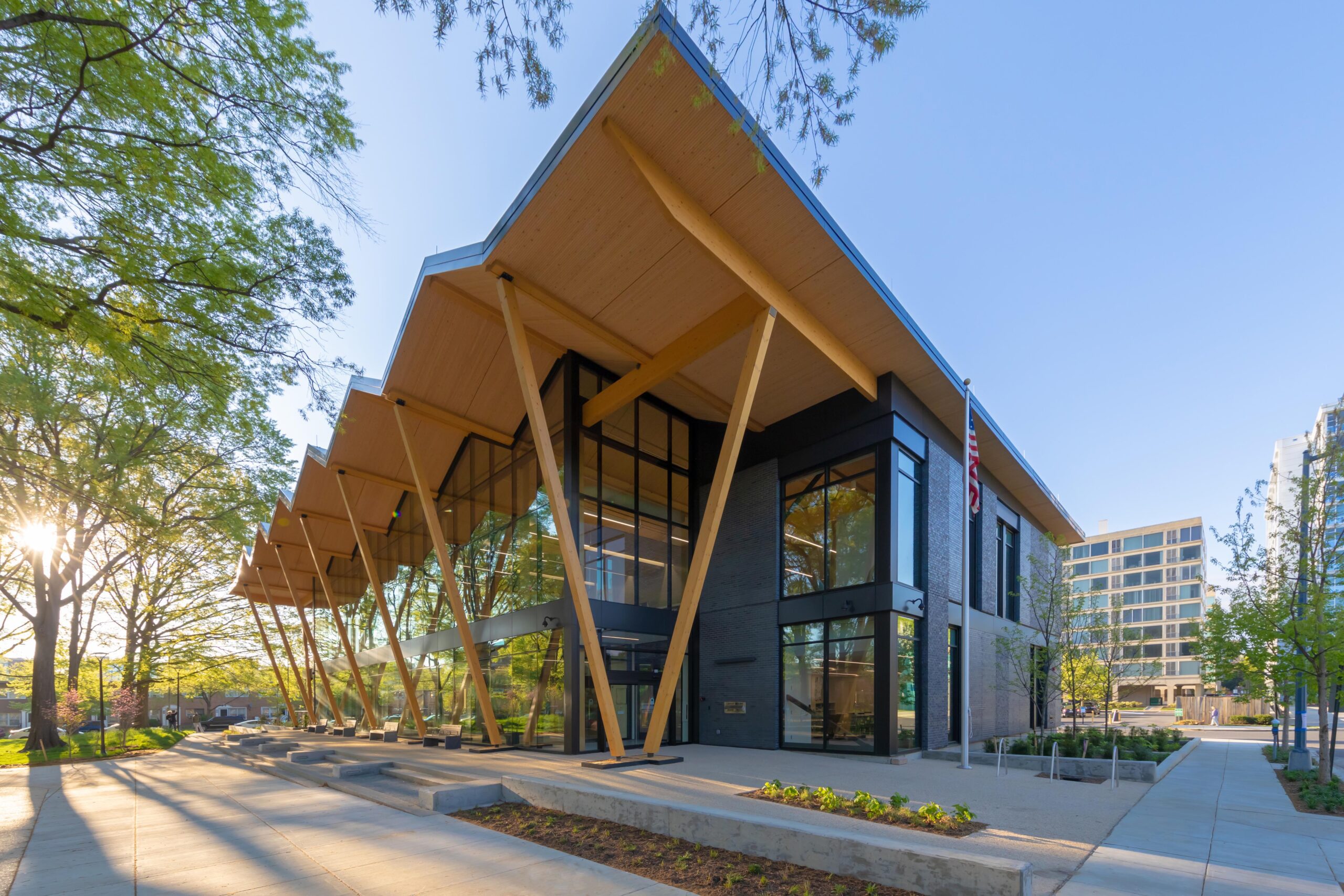
In Washington, D.C., Turner Construction Company constructed the gorgeous, light-filled Southwest Library using a mass timber-steel hybrid, incorporating steel elements as part of the lateral force-resisting system.
“We try to use the material that fits best to a specific project,” said Ignacio Fernandez, Senior Structural Design Specialist with Turner.
On the East Coast where mass timber is being used more, that can mean adding steel to the hybrid structure due to the ready access to steelworkers and fabricators in the region.
Designing and constructing a unique hybrid structure, however, presents an array of challenges. Each material has distinct construction and fabrication tolerances, as well as unique responses to changes in moisture conditions.
“Steel and mass timber are good candidates for a hybrid because they have similar construction and fabrication tolerances,” Fernandez said.
One Turner project on the West Coast that combined mass timber with precast concrete, however, required design and construction teams “to accommodate the different characteristics of those materials,” he said. “For example, you have to leave some gaps for the CLT [Cross Laminated Timber] panels to breathe.”
Construction of hybrid structures, he added, also requires a “mixed crew” of craftspeople who understand both structural elements, how they work together and how each component needs to be handled.
“I see more unions doing training for ironworkers to transition to mass timber as we are seeing mass timber get some traction on the East Coast,” Fernandez said.
Hybrid mass timber structures, he added, are also being utilized in new markets, including multifamily and student housing for colleges and universities.
“I see it more in residential buildings where you can get a higher rent per tenant because of the appearance,” he said.
Structural systems and evolving building codes are enabling exposed mass timber to be used in taller buildings — up to 12 stories in some jurisdictions.
Even though a mass timber-steel hybrid structure itself is more expensive than a conventional structure, the design choice delivers other savings that can make projects more attractive.
“Compared to a concrete building, it’s a lighter solution, so you are going to save some money on foundations,” Fernandez said. “You also save on finishes because the mass timber becomes your ceiling.”




Great transformations
From Pre-K to the Pros

Chick Webb Memorial Recreation Center